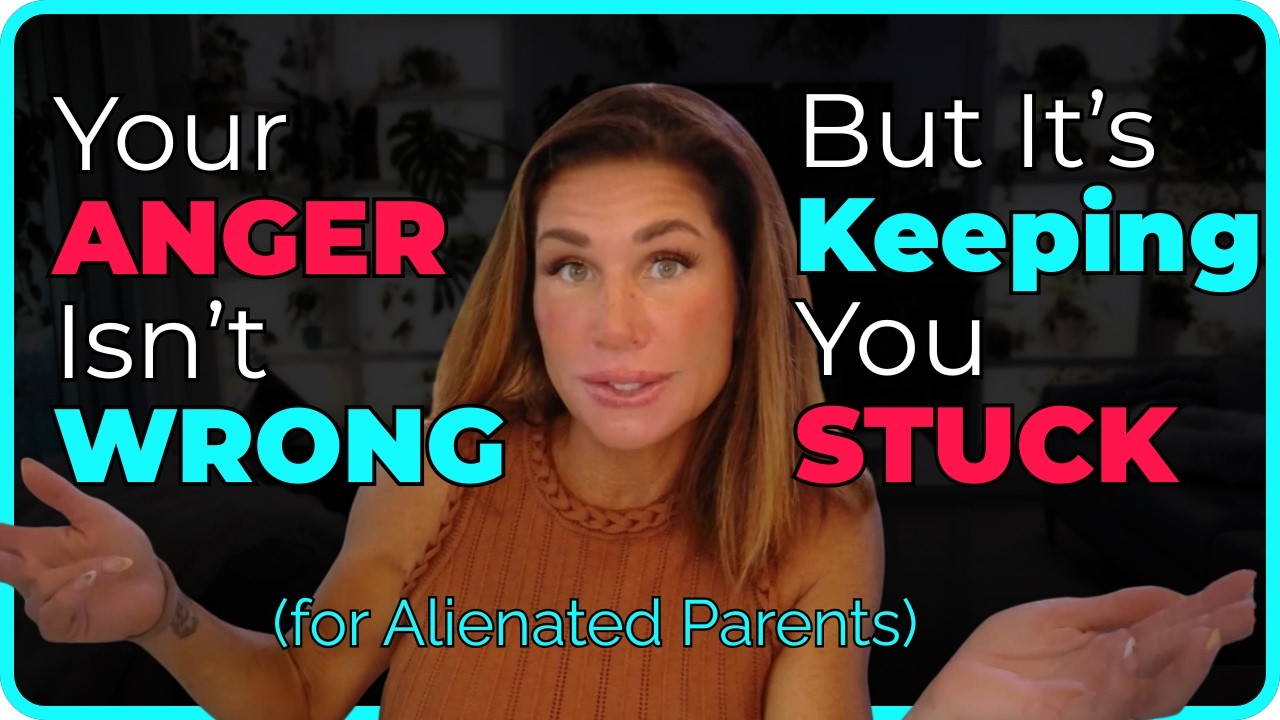
Auto-generated from the episode audio, so expect the occasional wrong word. Tap any timestamp to jump to that moment on YouTube.
0:00We've all been there. You get a message out of nowhere from your ex or from your child, and it's filled with coldness, accusations, and maybe even outright lies. Your heart starts hammering, your chest tightens, and within seconds an overwhelming wave of white-hot anger washes over you. You throw your phone into the chair, right? Or maybe you fire back some furious defense. Perhaps you silently punish them while seething underneath the surface. In that moment, it feels like the anger completely hijacks your body. It feels like they made you do it, and maybe you even hate them for that because you know that feeling that anger is miserable. But because the injustice from your ex or
0:43whoever's on the other side is real and so deeply unfair, your brain tells you that you have every right to just sit in it. And you do have every right to sit in it. But in a moment, we're going to talk about what's actually happening underneath the hood. Right now, I'm going to start by saying welcome to Beyond the High Road podcast. This is Shelby. Episode 200, you guys. We're in episode 200. Yay, us. So, stay tuned. Welcome to Beyond the High Road, a podcast dedicated [music] to healing your heart and life following the grief of alienation. I'm your host, Shelby Malford, a twice certified life coach specializing in post-traumatic growth. If you're experiencing [music]
1:29the effects of alienation and you're ready to heal, then this show is my love letter to you. Stay tuned. But ask yourself, what happens next? You get off the phone, or you walk away from the keyboard, and later you feel exhausted, completely drained, maybe even sick to your stomach. The anger that you were feeling or maybe still feeling doesn't fix the alienation. It just burns up your peace of mind. It'll often take up space in your life for hours, for days, for weeks, and yeah, for even years sometimes without even realizing it. And to add insult to injury, the other side, the person that you're angry at, usually the ex or whoever is involved, uses your angry
2:12reaction as proof that you're the unstable one. You're the unstable one. It's a trap, and it leaves you feeling utterly powerless. So, today we're going to be diving into Alfred Adler's separation of tasks to find out how to drop the riddle of your ex's behavior, and I will talk about that more in just a few minutes, okay? We're also going to look at the psychology around his concept around fabricating anger, and we're going to look at the hidden payoff that your anger is chasing, why it's actually keeping you trapped in the alienation cycle, and most importantly, how understanding all of this allows you to completely reclaim your energy and your power. Okay? Because let's be honest for
2:58a second. Some of you might be sitting there thinking, "Yeah, but wait, my therapist or whoever, some book I read, told me that finding my anger is a good thing. I've been numb for so many years, so feeling mad means that I'm finally moving forward." And you You know what, you guys? That school of thought is completely right in the the way that I think, right? Anger is a phenomenal alarm system. If you have been frozen in grief or passivity as so many of us are, right? Have been. Feeling that initial fire of anger is a sign of life. It is a sign of movement. It's your brain saying, "This isn't right. I deserve better, and I want more for myself." But, here's the trap. Alarms are meant
3:43to wake you up, not become the ambient background music of your life. Think about it this way. If your actual alarm clock, like the your morning alarm clock, goes off at 6:00 a.m. I can almost bet that y'all don't lay in bed until noon listening to a Blair telling yourself, telling your partner that you're just processing the morning. >> [laughter] >> Just processing the morning, it's fine. No, you get up, you turn it off, and you usually start your day. For the most part, right? But when we use the excuse that our anger is healthy just to justify leading into anger long-term, right into that emotion long-term, we've hijacked a good psychological concept
4:23and turned it into, like I said a minute ago, an alibi or an excuse. Which it's This is a common thing. So, I'm going to get into this in a minute, but So, this all came up for me, y'all, this past week or so. One of my clients was asking about something that reminded me of a book that I read back in maybe a 2019, 2020. In fact, it was back in those days where if you guys have been long-time listeners, you know that I was listening to listening to and reading Mark Manson. Um he was like my first real step towards my healing, right? I mean, I had dabbled and listened to a bunch of different books, but I really started putting the pedal to the metal when I started listening to
5:09him back in the day. And um I even kid around that I joined his club, which was really just his like subscription, whatever, but it was his first one. It was like a little long time ago, you know? Anyway, he had talked about in one of his I don't know what it was that I was listening to of his or reading of his, but he had talked about the Adler a lot, and then also suggested the book the courage to be disliked, okay? And that's where the other day, when I was talking to my client, something he said reminded me of this book, and then of course I referred this book for my client to read. Okay? Sorry, I hope that's all making sense. So and then it got me to starting to really think about
5:56Adlerian psychology and that's really what I want to share with you guys here. It's funny because anytime I think about anger and anger in the way that I'm going to describe it today, I always go back to this book. Um and you guys if you haven't read it, it's a great amazing book that gets down to the nuts and bolts of emotions and personal responsibility and not having to use personal power is what it really is. Oh, it's what it all boils down to. It also sense of community. It's everything. It's a [ __ ] It's a fantastic foundational book for anybody to read. So I highly recommend it. Having said that under Adlerian psychology emotions are tools that are used for a
6:41purpose. That's just the way he thinks about it. Where like Freud relied on etiology which is like how your past trauma causes all present issues in your reality, right? Adlerian He calls it teleology argues that behavior is driven by your future goals, like what you want to accomplish. Which sounds crazy when we're talking we're using alienation, but I'm going to break it down especially in this today's episode as it relates to anger. So the way Adler thought about things is that we do not act because [clears throat] of what happened to us. We Stay with me. Pick our emotions to get what we want right now. Again, just stick with me. So I'm going to provide an example right
7:30off the bat to demonstrate how this plays out in real life. Okay? Because if not this can sound a little off-putting. I'm going to be get fictional today so that I'm not calling any of my clients out. So, let's call her I've named her in my little outline here. We're calling her Sarah, okay? Sarah's son just graduated from high school, okay? And because of the alienation, Sarah wasn't invited to the ceremony. But she and her ex spoke beforehand, and he had promised her he's one of those, you know, there's different types of alienators, and he in my story here, he's the kind of alienator that plays nicey-nice on the outside, but does the stuff on the on the on the sly, you know, the
8:13alienation tactics are done. He's the hero. He wants to play the hero in all the scenarios, okay? He's going to be the one that reunites them and does all the he's got the best intentions, okay? So, um because of the alienation, Sarah wasn't invited to the ceremony, but he promised to send a photo of her son in his graduation gear before the ceremony started. So, graduation day comes and goes, no photo. Three days later, Sarah finds a picture on social media posted by a relative. Her son looks beautiful, gorgeous, right? But the ex completely broke his promise to her. Sarah is instantly consumed by blinding fiery rage. She's not sleeping. Maybe she stops
9:02going to her weekly yoga class, and when it comes time to let therapy, whatever else, she reschedules it saying, "I'm just too angry to focus right now." Honestly, though, it doesn't matter. She's feeling righteous at the same time because I haven't stood up for myself in years. So, sitting with this anger feels like good healthy movement for me, right? I deserve to have this anger. I've been so nice and so forgiving and so la-la-la, and now I'm angry, right? And so, 3 weeks pass, and Sarah is still sitting at home pacing her living room, deeply analyzing her ex's narcissism, and completely checked out of her own life. Okay? Now, from a trauma-informed lens,
9:50we could say, "Yay, good for Sarah. She's finally angry at how unfair this all is." But Adlerian psychology asks us to look a little deeper at the purpose of Sarah's anger. Why would she be choosing to manufacture a 3-week storm over this broken promise, right? And so, my answer to that is Sarah's brain is using anger as a tool to accomplish two hidden goals that she doesn't know that she's doing, right? This is just a pattern for her that she doesn't many people and I'm going to explain my own patterns with this in a little bit. It creates an alibi for her to stop growing. As long as she's too angry to focus, she's a valid excuse to cancel her counseling, to skip her yoga
10:37classes, to maybe check out of her personal relationships, and pause the terrifyingly hard work of building a life outside of alienation. So, that's one. Two, it protects her from a much cleaner, yet sharper, pain. If Sarah drops her rage at her ex, she has to sit by herself and face the real data. Her son graduated, she wasn't there, and she misses him terribly. That grief alone is a devastatingly heavy void. Her brain looks at that void, panics, and says, "Quick, fabricate some fire." It's all done unconsciously. "Let's obsess over the ex instead, because fighting a villain feels way more empowering than missing my son." So, the bottom line of all this, or the
11:24realization here, is that the purpose of indulging in anger is to give us an alibi, like I discussed, so that we don't have to the next hard step of acknowledging, which will ultimately lead to the rebuilding of our lives on a solid foundation instead of on sand. Okay? So, now we're going to talk about the idea that some people have that anger is uncontrollable. I used to have this this belief, too, that my anger when I felt anger, when something outside, somebody did something to anger me that I wasn't really responsible for what happened next because they shouldn't have made me angry, right? So, the book, The Courage to Be Disliked, uses this example of a mother
12:08who's yelling at her child. Okay? In an uncontrollable outburst. She's mad at her child. But then when the phone rings and the mom picks it up, she immediately changes her tone to this polite, calm voice. When she hangs up, she goes right back to the yelling. I turn into my mom doing this a lot and maybe I did some version of that at some point with it even with my own daughter. I don't know. But it demonstrates this idea of going from one to the other. You have to be polite around people that you don't know. Somebody comes to your door and you were just yelling at either your kids or your ex or somebody and then all of a sudden somebody comes knocking on your door
12:48selling something or whatever. Maybe it's a neighbor coming to borrow some eggs or something like that. And immediately you open the door and you're like, "Hi. >> [laughter] >> How are you? What's going on?" And then you shut up the door, the neighbor leaves, and all of a sudden the next thing you know, "Ah!" Right at your kids or whoever you're mad at, right? I mean, I think everybody's been guilty of some version of this at some point. But it demonstrates though the kind This kind of example demonstrates that anger is not uncontrollable. It's a conscious or semi-conscious tool pulled out to make another person submit or listen. This actually reminds me
13:27of my ex a little bit, too, that he was a a hothead. In college, he was notorious for it. We worked at the same bar. I mean, I say worked, he only did a one night a week, but um he would come in and he was known to like headbutt people that he just didn't like or that looked at him wrong or that you know, whatever. He was just known this was his MO. And I was actually attracted to that to that behavior because back then this is what a strong man looked like for me. He wasn't afraid to assert himself where applicable or when he needed to. Now I see it as so much different. So like on the night before our wedding and maybe I've told this story before, I don't even know,
14:15but it's one of the ones that kind of sticks in my mind. I don't think about that often, but when I think about anger outbursts, this is one of the ones that comes up. I was on the night before our wedding on the that dinner we got married in in South Africa out in the bush, but that night that or the weekend that we got married, there was this 100-year flood, so our whole wedding got moved from out in the bush on safari, right? To this English garden sort of wedding place. And so it was a bit high stress, you know, or not a bit, there was a lot of stress that went on that during that time. I don't know how I remained so chilled out. Doesn't really matter, but so the night before
14:53our wedding, I stood up at dinner. It was a four-course dinner. I stood up just said announced and changes that were going to be made for the activities the next day. What was going to be going on while I was getting dressed and all the things. And one of our wedding guests, he actually crashed the wedding, but that's besides the point right now, made some smart-ass sort of comment about what I was saying, but it was all jovial. It was done in good fun, you know? But my ex flew over from our table over to his table, picked him up by his throat, and carried him to the outside ring from this picture window like where everybody could see, and he launched him across
15:32the S Garden, right? I mean, it was a moment, let's just say, you know? I don't even know what happened to that kid. Like, how what happened afterwards. I'm I I I'm assuming he was fine, but you know, anyway, I think they left the wedding that moment. The mom's faces, like his mom, my mom, I mean, uh priceless, awful. But, in his mind, my ex's mind, it was like cause effect. He shouldn't have said anything. Now that he said something, this was what happened. He shouldn't have made him angry, right? But, it wasn't really the whole story because as we know, anger is a secondary emotion. It's always a cover-up. Anger is always a cover-up. For me, too. Like, I used to
16:19use anger to get what I wanted in a relationship, you know? I would either get to act like the righteous one who did no wrong, right? If I decided if somebody in a relationship that I was in did something that I didn't approve of, then I could use anger to feel like the one the better one. I could also be a little bit high and mighty, like if you wouldn't have done A, then B wouldn't be necessary. I wouldn't have to do this. I wouldn't have to act like this. And it sort of took this, I don't know, punitive toll with them, right? It also I loved being in that kind of anger because it felt powerful, you know? Because then I got to to make them submit to me. I would also other times
17:04would fly off the handle completely, outwardly insult, and punish, and then blame it on them for making me so mad. Same kind of thing here. But, I would be the one that was like you know, I'd go nuts in effort to make them again either submit or try to control their behavior for the next time. So that they wouldn't remember that. And then would try to avoid doing whatever that they did to piss me off to begin with. You know? There's always a motive behind it. And I've done it even more recent. And most of that anger, like when I've done it more recently, it's been on the inside where I have had this self-talk where I've been mad at somebody else. And I sort of fabricated
17:45and up leveled the anger to the point that it served whatever hidden agenda that I didn't even really realize that I had at the time so that I could do that agenda and make that the end result of like, in the case that I'm thinking about right now, so I'm not being all vague. It's like back when I was watching dogs. That's all liver, by the way, except for my dad's dog. And he, you know, whatever. But anyways, when I was watching dogs and so a dog would like do something, pee in the house or something like that. And I would be seething on the inside. And then up level that anger and sit in that anger about this dog that peed. It's not a problem. I have tile floors. But I
18:26would get angry to the point that it caused me to talk myself out of ever watching that specific dog again. Do you know what I'm saying? Like it I used it as a tool to rationalize or justify why I wasn't doing the deed of watching whoever's dog. Do you know what I'm saying? And so in that case, all I needed to actually do was be honest with myself about the fact that I didn't want to watch any dogs anymore. That's all I didn't need to feel the anger. You know, I don't need a justification for that. I could just make up my mind that I don't need to do this anymore. You know what I'm saying? But I created all this whole other [ __ ] storm basically for myself. It was like I was
19:06imploding on myself trying to drum up some sort of um motivation so that I could stop doing the doxing. And I've done it in a million ways, and it's okay. Listen, y'all, if you are doing this where you had used anger in order to justify the means to an end, justify your desire to control the outside environment, whatever it is for you, it's okay that it happens because it's natural. It's kind of a a human tendency. And when it comes to to alienation, what we what's going on in our lives, it makes a it makes so much sense. What's not okay, though, well, I guess it's all okay, right? But what I decided is not okay for me is to let that anger fly under the radar and continue.
19:57Okay? So, my goal is to always to catch it while it's happening in the moment so that I can disarm it and get to the root cause. Because just like I mentioned a second ago is that anger is a secondary emotion. There's always more underneath. Anger is just the tip of the iceberg. So, in standard psychology, a primary emotion like fear, shame, anything under the grief umbrella will trigger the secondary emotion of anger as a defense mechanism, right? The Adlerian twist is that he argued that you consciously or unconsciously look at your primary emotion, feeling hurt or disrespected or embarrassed, whatever it is, and realize that showing that makes you look vulnerable. All like I said,
20:49usually done unconsciously because being vulnerable doesn't help you dominate a situation, you will fabricate anger as a tool to achieve your goal. Okay? The primary emotion is the raw material, anger is the manufactured product used to get where you want to go, okay? So, the the easy way to remember this is primary emotions are the fuel, anger is the tool. Number two is that anger, the rule is that anger hides the vulnerability of inferiority. And so, when I say inferiority, a core pure pillar of Adlerian thought is that the inferiority complex which the way that he looks at it is the deeply rooted anxiety of being inadequate, weak, helpless, right? Like
21:41so many of us feel. That's the alienated parent's experience, especially in the early days before you're managing your mind. Those primary emotions of embarrassment, helplessness, rejection, whatever, are direct exposures of our feelings of inferiority. Because facing inferiority is incredibly uncomfortable, we utilize anger as a secondary emotion to instantly mask it. Okay? So, anger makes us feel powerful. It makes us feel righteous and in control, effectively creating a temporary artificial sense of superiority. This is what I always talk with my clients about, like I want to say the word I wanted to use right there is what I warn my clients about, but
22:31that always sounds so like alarming, and it's not about that, but it's just something to keep in mind is that when you start judging, and you guys have heard me talk about this a lot, is that when you start judging anybody, you will end yourself up in a spiral, in a shame side spiral. So, anything in vertical relationships, which I'm going to talk about in a minute, when you are higher in your mind, or that you put them higher, either way, you're going to end yourself up in this spiral of self-hatred, self-blame, self-whatever, right? It's not beneficial. It doesn't help. It doesn't do anything except for keep you in a standstill. Basically, what I'm saying is just that anger is
23:13uh an easy escape if you're feeling inferior, and by inferior I mean inadequate, weak, helpless, rejected, uh chastised, anything like that. I'm going to give you a couple different examples real quick to explain what I'm talking about here. So, the example that I have written here is that maybe your primary emotion is fear. Let's say that you're terrified because your teenager stayed out 3 hours past curfew. The Adlerian function is if the parent shows fear, then they're admitting vulnerability. You would be admitting vulnerability if this is you. And fear does not force compliance. If you Your kid comes home late, 3 hours late, maybe even a little bit drunk or something,
24:02if you were just, "Oh my gosh, I was so scared for you. I can't believe Are you okay?" Your kid could easily just feel like, "Oh, it's okay, Mom. Don't you worry." It doesn't force compliance, right? So, therefore, instead, you or whoever's doing this will fabricate anger, right? The secondary emotion, to yell, to assert dominance, and to force the teenager to obey next time. So, anger came out in order to get your kid to follow in line. And another example I have here, maybe the primary emotion is hurt, grief. Maybe your partner feels neglected or beaten because you forgot their anniversary or something. An Adlerian function, expressing sadness requires a high degree of vulnerability again.
24:51Instead, they pull out anger as a weapon to make the spouse feel guilty, put them on the defensive, and control the narrative. Just exactly like I was saying about me, right? It's a way if you are really sad, hurt by something that they did. Depending on the relationship and if you're not managing your mind, it's much easier to yell and to talk down to them and tell them how rude or whatever that was. It's so much easier in that place because then you don't have to be the vulnerable one, you make them the vulnerable one, right? I'm not saying it's nice, I'm not saying it's right, but it's just it's so common to do. I guess the takeaway to that is that according to Adler, as long as you treat
25:33anger as a primary uncontrollable force, right? You end up remaining a victim to it. By recognizing that anger is a secondary choice, conscious or unconscious, you can practice what he calls the separation of tasks, what we're going which we're going to talk about in a second. You can learn to sit with your primary vulnerability, right? Hurt, fear, sadness, whatever it is, rejection, communicate it cleanly, and then release the desire to use anger to manipulate the other person's behavior. Like I was sharing that I did before. All right, so now we're going to visit the separation of tasks, okay? Which can be really, really helpful. In fact, you've probably heard me talk about this
26:18from time to time throughout depending on how long you've been listening, but it can be really helpful around well, so many things. Like if you're um wanting to change how somebody's behaving or if you're wanting to change how somebody thinks about you, believes about you, you know, like your kiddos um and what have you. It's just a way that you can cleanly empower yourself. So, in Adlerian psychology, conflict management, even inner conflict for you, management relies heavily on the separation of tasks. The concept itself states that almost all interpersonal relationship problems arise because you are either intruding on other people's tasks, you meaning anybody, >> [laughter]
27:08>> or they are intruding on yours. Okay? By clearly defining who owns which tasks, you can eliminate unnecessary anger, manipulation, and power struggles in general. And you really only need one person to be doing this. That person being you. Me. Whoever's applying this. The first step in the separation of tasks is to identify the owner. Okay? Whose task is it? To resolve any sort of conflict, you want to ask yourself one diagnostic question, which is basically who will ultimately receive the end results of the choice made. Okay? So, your tasks, anything for me, allow me to speak about me, so I'm not pointing the finger, but my tasks would be my thoughts, my emotions, including my choice to
28:04fabricate anger, right? My choices otherwise, right? And also my reactions to others. Those are my tasks. Their tasks, anybody else's outside of me, are their emotions, their opinions of me, their life choices and whether or not they decide to change. It's all theirs, right? This aligns perfectly with everything that I've shared with you guys um on a weekly basis, right? So, what's outside of you, you cannot control. Of course, what's inside of you, that's what you can control. It's This is really especially helpful when we think about what I just mentioned a second ago um about when we really want somebody to to, you know, like us or respond to us in a different way.
28:47Because then you can remember, okay, wait, that's not my task, right? And step two with this, after you've figured out whose task it is, you want to establish, we're talking about the interpersonal relationship problems, right? Establish do not disturb boundaries. So, once you determine the owner, you must actively separate actively separate the tasks. So, one of the biggest things is you don't want to carry their emotional weight, their baggage, okay? If somebody's angry with you because you set a healthy boundary, their anger is their task to process. It's not yours to fix. This is huge and it will change the way that you operate, the way that you feel, the inner the
29:32amount of energy you have on a daily basis when you are allocating your time, your energy to the things that you can actually control, right? It makes so much sense. It's so simple, but it's sometimes doesn't seem so simple when we're in it because we're so used to many of us, many of you are used to taking responsibility for how other people feel about anything that you've done or haven't done. You know what I'm saying? Oh, well, I didn't want to make him feel a certain way or I didn't want to do What you know, we overcomplicate and we take on too much that was never ours to begin with. And that will cause this other kind of like resentment, which will then, of course, steam steam,
30:15steam until it turns into full-blown anger for you. So, don't carry their emotional weight. And then also, the other point that I think is really important to make here is that you don't you cannot, and I don't think that it's helpful for you to try to force a resolution. Okay? And this goes to not just for your kids, but for anybody. So, you can control how clearly and kindly you communicate. That's yours. You can control that, right? You cannot control whether the other person forgives you or agrees with you. Forcing them to agree is actually intruding on their task. Okay, and actually to what trying to get them to if I'm ruling away from the actual the anger portion of
31:04this right now, and if we're talking about um just interpersonal relationship problems that lead to anger, um you wanting to influence their thoughts about you, their um yeah, their opinion of you, that also is intruding on their task. It seems like feels so necessary to show somebody the whole picture. But wait, I was just trying to This is what I meant and blah blah blah blah blah. I'm not saying it's wrong to do it, but when you manipulate a situation I'm not calling you a manipulator, it's just human nature, but when you try to manipulate a situation so that somebody or manipulate a person's opinion of you, you're actually it's a reward or a punishment based way
31:57of thinking, I guess, about having intervened in another person's tasks. Okay? And I actually believe that I just paraphrased a quote from that book. Cuz it was one of my favorite most mind-blowing in the moment like life-altering epiphanies whenever I read that part. That trying to change how somebody else thinks of you is a reward oriented way of thinking about having intervened in another person's tasks. I think that that's the actual quote. So, either way, a reward or punishment way of thinking about our kids and how if we think that we can change their opinion then that's a reward that we'll get. I don't know if I'm going to be explaining this right without getting into the weeds, but it
32:48ends up causing you to feel like you're having to bend everything in order to help them along with their narrative and it's really their task no matter how old they are. So, do not force a resolution. Forcing them to agree is intruding on their task. And then the third point I want to make about separation of tasks is you want to shift from having these vertical relationships to horizontal relationships. Adlerian psychology views conflict as an attempt, any sort of conflict, anger, as an attempt to establish a vertical relationship, a hierarchy, right? Where one person is superior and uses anger to guilt or to dominate or manipulate. Okay, to manage conflict or to lower conflict, you want
33:37to shift to a horizontal relationship where everyone is equal but different. That everybody has value to offer here. You know, even the alienating parent, which is going to be very difficult for you, but if you can get to a place where you can just see them as equal, neutral, different, you're going to have a lot better experience yourself. You're going to experience less anger and will be able to think more clearly and be able to, I know this sounds a little bit contradictory from to what we're talking about here, but be able to strategize better for what you do, how you show up in your life in a way that in a pre-decided way. You know what I'm saying? You'll be able to show up in a
34:26cleaner way. The idea here is that you don't want to praise or rebuke. So, either way, you're not looking down and judging and they suck, they're the worst because they do this, that, and whatever. And then the other hand, you don't want to either praise yourself, praise them, put them up on a pedestal. It's just everybody is equal and different. I put this in a little step-by-step application. Like let's say you're angry, you're not [ __ ] feeling it, whatever's going on for you, right? So, step one is to pause and to recognize if you are manufacturing anger to force an outcome. So, your internal dialogue here may be something like, I'm getting angry because I want them to
35:10change. That's what it would sound like for you. Number two, step two, is to separate. The action here is determine what you can control versus what they can control, okay? So, your internal dialogue here is expressing my boundary is my task. How they react is their task. Okay? It's just I can set the the boundary and then just let it go, like a butterfly setting it free. That's and then that way it keeps things very neat, clean, and nobody's getting resentful for taking on responsibilities that aren't theirs, okay? Number three is to communicate. This is the active active part of it. When you state your peace to the other person, if you're actually in communication with them, assertively
35:57without expecting any specific reaction, okay? For instance, a way for my elucidation, the idea is here is is I cannot do this favor for you today. Maybe you say, I don't want to do this favor for you today. I don't want to drive your kids to school today. Sorry. You know? And let them all see number four, jumping ahead. Number four then is to release. So, it's pause is number one, separate, communicate, and number four is release, okay? You let go of the need to manage their emotional fallouts, if there is any. So, your internal dialogue for this would be, "They're upset with me, but I am not responsible for managing their mood." Which keeps things very clean for you.
36:46Then that way, anger doesn't have to come in and try to save your day, you know? Or muddy up the waters, really. So, I want to give you guys a stewing mode checklist right now. There's so much I had like much more to say. I have had like probably four or five more examples that I wanted to give to you guys today, but I also didn't want to make [clears throat] it a super long episode two today. So, if you do want more of this, then I'm happy to do a part two, and where I can go into the examples, the other examples I have listed here, or like what the anger is hiding. So, it'll it I did one example, I won't go all the way into it, but like basically when somebody gets butt hurt like in the
37:37office for somebody's stealing their thunder, and what how that looks on the outside for the angered person, the person who feels like their thunder's been stolen. And so, how they act out in the moment, and then what emotions they're actually covering up, because those emotions that you're actually covering up, this I'm glad I'm saying this right now. I mean, not give I'm not giving any examples, but saying this will help you guys, hopefully, um in the moment to assess what's going on for you. Because those emotions that you're actually covering up, the primary emotions, are how you can help yourself to make the anger help your brain to notice that the anger is not actually
38:28helping you and in fact it's not attractive to you to do it anymore. So, instead you can find what the anger is trying to cover up and then recognize the feelings for what the primary emotions for what they are and then allow yourself to feel them and then everything can be let go. But when you allow anger to rule your world, then it keeps you in this like cyclone of inaction or self-sabotage or sabotaging even the relationships that you're in. And so, if you notice that you have a bunch of you know, a handful of relationships that have blown up or dissipated because possibly because of the your anger, maybe it was a combination of things, but you notice on your side of the
39:15street that there was a lot of anger that you were holding and then also you notice that those relationships have fallen away, then it would be really helpful for you to look at this, okay? So, I hope that all made sense. Now, I'm going to give you this doing mode checklist, okay? So, you want to ask these these four questions to yourself, okay, to find out if your anger has crossed the line from a healthy alarm system, like we're talking about in the beginning, into indulgent stagnation. Because anger, in the way that I'm speaking about it today, is of the indulging kind, okay? The first question, question number one, is are you canceling your growth? Are
39:55you putting your growth on hold? Are you rescheduling appointments, skipping workouts, or maybe even isolating from friends or other systems that you put in place because you're too upset to focus or because you're too distracted or whatever it is. So, that's number one. Are you canceling growth? Number two is are you playing the psychological detective? Y'all, this one's important and I actually wish I would have talked about this more throughout the episode. But, are you spending hours or days analyzing your ex's motives, hidden agendas maybe, or predictable bad behavior? Is that what you're wasting your time on? And I don't mean to be rude when I say that, but so many parents will spend
40:43hours pacing in their house or wherever, mulling over, trying to figure out what their objective is, what their motivation is. You're playing the psychological detective. Going over the narrative about how they are the narcissist and how it always shows up and blah blah blah. Trying to figure out them, their inner workings, you know? So, that's question number two. Are you playing psychological detective? Number three, is it four? No, it's three. >> [laughter] >> Are you treating your anger like an activity? So, if you're sitting on the couch, pacing the floor, replaying arguments, mistaking the physical intensity of rage for emotional progress, then this might be a clue that your
41:26anger is becoming indulgent, okay? Are you treating your anger like an activity? And number four is, are you hiding a harder truth? Like, keeping yourself furiously focused on what they did wrong so that you don't have to sit with the quiet, helpless grief of your current reality. Like I mentioned in with my fictional example of Sarah. If you are consistently focusing on and find yourself looping around like you want to take responsibility and you think start to consider, oh, well, I might have done this, but that's because they did that. If you're constantly going right back around, trying to play detective, trying to divert like all of your attention towards them,
42:09and it just fuels you is like over and over again, then this is this might be something that's going on for you. And it might be so much so that it's a habit for you at this point. And so it just loops, you know? And even though you're sick and tired of doing it, I can remember this for me. Sick and tired of hearing yourself think, talk about it. It's cuz it's like it's like pressing a play on a cassette tape, right? The same stories come up for you. They did for me anyway. When I wanted to I was more apt to place blame than I was to take responsibility, you know? And it caused so much upheaval in my life. And I was exhausted all the time, but also it was like tired and wired, you know?
42:54Um like activated. It was awful. And so anger when it's become a habit for you and your body, it is so uprooting. And it's like I said, it's also exhausting. It feels so much better to set the anger down and come to a place where you can see everything like I said in that horizontal plane as opposed to up and down vertical. Like that somebody's up on a pedestal. Whether that's you or them, it doesn't matter. Neither of them are better positions. Now, I will say though you guys before I close out with you guys, that anger does feel better. And we've had I've done other episodes on this where I've talked about righteous indignation, you know, and I've talked also about outrage before,
43:41too. Where anger does feel way better because it's a it's a fake kind of power where you get on a like there's a a push inside of you. It's a higher energy, right? It's a higher vibration than grief, than emotions of grief. But anger is also not usually productive unless you make it productive. Unless you decide to use channel your anger into like I also did an episode on this is just reminding me of it now instead of hating injustice loving justice. Then you can use your your anger and that anger will actually sort of transmute or like change over time into motivation and purpose. So I'm not saying that anger's always a bad thing. The problem is when it becomes indulgent when it starts to
44:37interfere in all of your relationships or even some of your relationships. So if you went through that checklist right now with me and realize that you've been lying in bed listening to that alarm blare for days or for weeks then maybe it's time to turn it off. Perhaps it's time to stop playing detective with a riddle that you are not assigned to solve. Your ex's choices are their task. Your child's choices are their task. But your healing, your choices are entirely your task. Okay? So maybe set down the fictional script, stop redlining your engine, and park revving your engine, right? And let the pain be clean. Okay? Clean pain will not paralyze you guys.
45:30That is why so many people stay in anger because they feel like if they slow down out of anger and go into the grief that they're just going to fall apart. Right? But so long as you're keeping your story clean and allowing to feel the emotions, process the emotions, this the way that I'm talking about will allow you to feel the sting, catch your breath, and then show up for your life anyway. Processing an emotion with the waves of emotion that come can really take 90 seconds at a time. >> Yeah. >> So, if you're like I said, if you're using anger as a way to keep you afloat, just know that in the long run, the anger is what's going to drag you down. You can simply process the emotion, the
46:20physical sensations or vibrations of an emotion 90 seconds. At most, 3 minutes, but really 90 seconds at a time. And you may have to process it, process and re-process as they come up for you, but that's okay. That's what it's That's what's how it's meant to happen, you know? So, that you don't go completely stagnant, inactive in your daily life. You don't have to take 6 months off of your life so that you can process your grief. I promise you, okay? So, go book that appointment, go to that workout, and go live your life today. I'll see you next week when we talk about trusting others. That's what next week's episode's going to be about, you guys, okay? All right. Take care.