
Make New Meaning: How to Honor Your Painful Memories for Alienated Parents
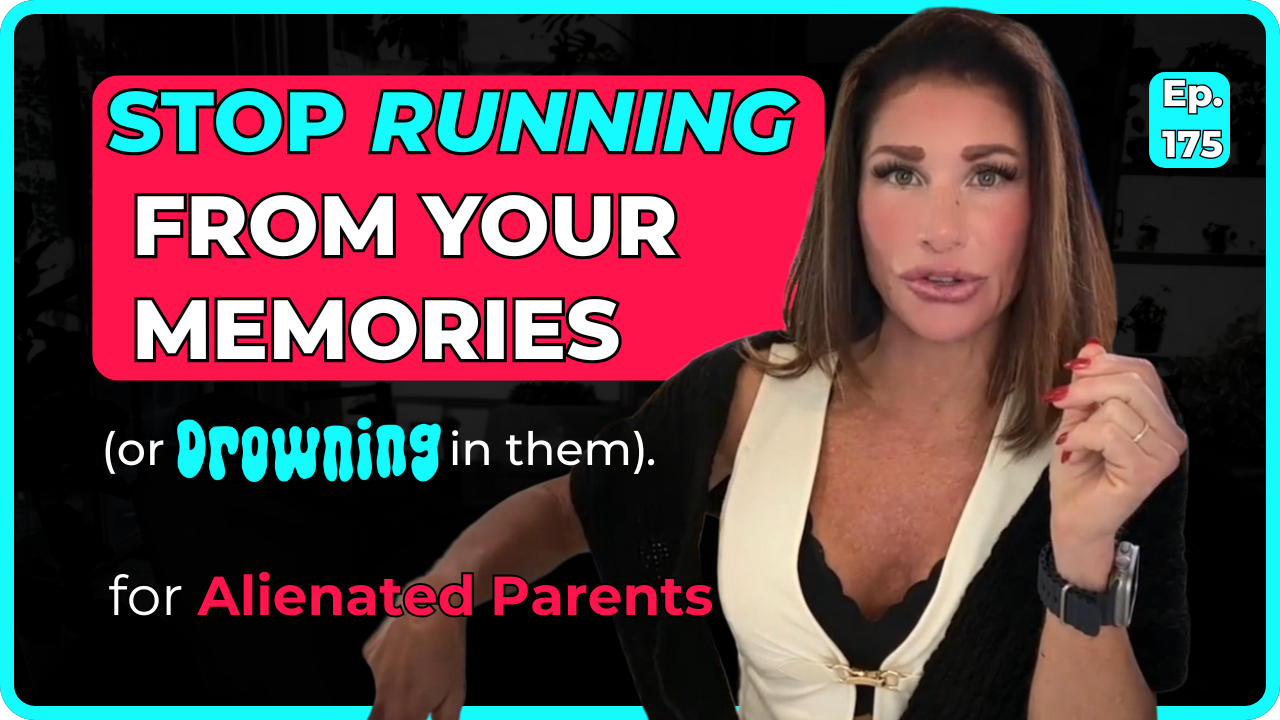
What if the memories of your child didn't have to feel like landmines? In this episode, I share how to reclaim your power over memories—so they become sources of connection instead of pain. Learn the nervous system tools that helped me stop running from photos, songs, and reminders, and begin honoring my relationship with my daughter in a way that feels true (to my soul) and clean (without suffering).
Main Talking Points
-
The Running Pattern: Many alienated parents spend years running—from abuse, harassment, and eventually from their own memories. Even sweet memories can trigger the body's escape response.
-
Window of Tolerance as Your Guide: Using your nervous system's "window of tolerance" (the range where you can think and feel simultaneously) helps you approach memories without drowning or dissociating.
-
Titration & Pendulation: These trauma-informed techniques teach you to work with memories in small, manageable doses—like adding drops instead of gulping the whole thing at once.
-
The Avoidance-Flood Cycle: Alienated parents often swing between two extremes—either avoiding all reminders (enshrining rooms, blocking songs) or doom-scrolling through photos while completely activated.
-
Recontextualizing Memories: Painful memories often become "muddied" with shame, terror, or trauma narratives. The work is separating what happened from the story you've attached to it.
-
Taking Back Control: Instead of letting algorithms, songs, or your ex control your emotional state, you can decide when, how, and how long to visit memories.
-
Normalizing Your Grief: While parental alienation isn't "normal" for most people, it is your reality. Fighting against "what is" creates suffering—acceptance creates space for healing.
-
Sacred but Accessible: Memories can remain sacred while also being part of your everyday life, not locked away on an untouchable altar.
Key Takeaways
- Create Controlled Activation: Choose a medium-intensity memory (4-6 on a 0-10 scale), set a time limit, and practice in a safe environment with regulating resources nearby.
- Touch and Retreat Method: Access one sensory detail at a time (a hand in yours, one line of a song), check your body's response, then pendulate back to safety before returning.
- Three-Step Protocol for Unexpected Triggers:
- Name the story (What am I telling myself?)
- Name the sensations (Where/how do I feel it?)
- Take three slow exhales with hand on the most intense body area
- Separate Shame from Memory: Identify what narrative you've attached to memories (often shame about not protecting your child) and consciously separate that from the actual memory.
- Ritualize Sacred Memories: Pick specific times (birthdays, Sunday nights) to intentionally spend regulated time with special photos, songs, or objects—then close the ritual.
- Stop Retraumatizing: Doom-scrolling photos while activated or repeatedly listening to triggering songs creates new trauma associations. Small, regulated doses build resilience instead.
- Redefine on Your Terms: You get to decide what memories mean going forward. The alienating parent doesn't get to control your internal experience anymore.
Episode Transcript
You are listening to The Beyond The High Road Podcast with Shelby Milford, episode number 175. Stay tuned.
Welcome to Beyond the High Road, a podcast dedicated to healing your heart and life following the grief of alienation. I'm your host, Shelby Milford, a twice certified life coach specializing in post-traumatic growth. If you're experiencing the effects of alienation and you're ready to heal, then this show is my love letter to you.
Stay tuned.
Hey y'all, how are we doing today? So we're gonna get started. I have been, just on the side note, you know, we're, I'm down in Florida, like South Florida and we've had, I've had a time of it. You should see anywhere you see behind me looks clean, but to the right, to over to the far left and all around, I have hundreds of plants that were outside, stored inside and the place is kind of in shambles.
It's been kind of wild, lost power a we're not set up for freezing temperatures in the twenties here in, you know, south Florida. And we got it. And I know the rest of you're in United States. I feel like all over the world kind of, there's been some crazy arctic blasts going on, not just in the United States, , I know many of you were probably affected as well.
So, um, hoping that you guys are all staying warm out there and we're gonna get started. But the reason I, I was saying that too was because I am out of sorts in my brain and what have you have sore throat for the past, like few days. So anyway, I sharing that for no other reason than, um, I might be a little groggy today, but it is what it is.
So we, today I'm gonna read you my little spiel here in a second, the intro, and then we're gonna get started. We have, um, the episode today is there's eight sections and actually I think that they'll go pretty quick. That's my intention for that anyway, um, but we're gonna be talking about memories. Just based on, and I'm gonna talk about it in a second, but based on, um, the last two episodes, pretty much, , sort of a continuation of those.
let Me pull up my notes and we shall get started.
Why Alienated Parents Run From “Good” Memories
📍 📍 For a long time, it felt like my whole life was spent running, running from the abuse, running from the harassment, running from private investigators, like quite literally running from them in my car and running from myself, running from the pain,
and after alienation happened, when memories came up for me, even when those memories were mostly sweet, my body wanted to run from those two. it was like an instant reaction for me. Every Facebook or Apple photo memory that popped into my notification seemed like it house. Each one of the memories housed a remote control into my heart and mind.
One tap, and I was yanked out of my day, out of my body and dragged back into the before and after of my love story with my child, you know, before the alienation happened. And after at those moments. And then after now not having her, I don't know about you, but I got sick of running.
I got even more tired of feeling like other people and also random algorithms were calling the shots in my daily life. So, if that's you two, this episode is about something different. Today we're gonna talk about how to start taking your power back with your memory.
when they come up so that you don't just get swept away, you have a system, You get to choose how close you go, how long you stay, and when you come back, what your experience, entire experience is like. So we're gonna use your window of tolerance today as sort of your guide rail safety rails to do this instead of either avoiding everything that reminds you of your child, or as I said last week, sh rizing, my, my client gave me the right word for that, enshrining, um, those memories and never touching them.
We'll practice visiting memories in small, manageable doses that your nervous system can actually handle. I'll walk you through how to notice when your body's slipping into like your run mode. escape mode, um, what to do in those moments. And in a simple experiment you can try. I am just gonna give you some real life examples and for you, a little experiment that you can try this week.
So that next time a song, a photo or memory notification pops up, it doesn't get to hold the remote anymore. You do.
Last week. We talked about how complex trauma and prolonged grief, sort of scra scramble your memory, some things will go foggy and other things stay razor sharp either way, where you lose track of dates, times, um, uh, the order of things.
And then oftentimes the most traumatic parts of the memory are what stays until you process through, So, today, basically in the continuation of that today is about what to do with that, how to access memories of your child in a way that your nervous system can actually handle using your window of tolerance, as a safety rail, as your guide.
So What I'm saying here is we're not here to rip off any bandaids, We're here to work with your body's limits so that you can reconnect with your memories without drowning or wanting to run. Okay,
Window of Tolerance 101 for Alienated Parents 📍 📍
so window of tolerance, just if you didn't listen to those episodes, the last two episodes is basically in this, most simply put, is the range where your nervous system feels regulated enough so that you can stay, present, think, and feel at the same time.
So that you are present, regulated and neutral if you will. when you are outside of the window, in the hyper, you are pan feeling panicky, right? Racing thoughts, urge to escape, spiraling, sort of rumination goes on. Then when you're in the hypo, this is when you're freezing, basically. It's when you're numb, space shut down, you don't feel anything, maybe you know you're, uh, disconnected, Disengaged. Like it, what does it even matter That's in the hypo. Okay. So anytime that we're gonna go intentionally touch emotional memories of our kids, we want to stay in or near the window, Enough activation to feel, but not so much that you flip into survival mode. That's the idea here. And what I would propose is that in the beginning, you want to create a controlled environment to do this.
So if you haven't been to therapy or you're not planning on going to therapy or seeing a coach or whatever, then you want to do this. You can do this on your own. Absolutely. You don't have to do either of uh, you know, see a coach or see a professional if you don't want to you, but you. It's helpful for you to create a controlled environment, controlled activation and deactivation. So rather than being at the mercy of overwhelming activation or numbing, shut down pendulation and titration, which we're gonna talk about here in a second, teach us how to work with your nervous system's responses.
So this means that you decide in a controlled activation, it means intentionally and gradually approaching activated states in a way that builds resilience rather than creating overwhelm. The work is not to be brave and blow past your limits. The work is to honor your limits and expand them in a controlled environment.
Why Accessing Memories Matters and Why It Feels Difficult
All right, so we're already at the third segment right now, and I wanna talk about, it's basically, um, what I've titled it is Why Accessing Memories Matters and why it's so hard. Um, and I wanna talk about the push pull that happens for most of us.
Avoiding Photos and Enshrining Rooms: Loyalty or Self‑Protection?
📍 📍 On the avoidance side of things where , you might either keep everything.
I was one of my clients, we were just talking about this with one of her kiddos where she is in contact with two of her kids, but not another one. And so she has what I did this too. She has taken all of her photos out, you know, of that one child out of her home, because for her she said it was too painful.
It reminds her of the loss. It just, you know, it's just too hard. And then for me, it was the same thing. Having things out For a long time, I couldn't do it because each photo, of course, just reminded me that I didn't have her anymore. That she wasn't here, that we weren't making more memories. Right. And so I will say that for me, I'm not gonna speak for all of y'all or even my client.
I know that, and this is, I'm already giving this away, but I know that what I was making each of those photos mean. Any of the photos at that, at the time that I didn't have 'em up, um, was really where the problem was. As always, you know, it's always about our story. What we're the narrative that we're holding onto.
And most of the time that narrative is so, is done unconsciously, we're done. It's just done, um, from trauma brain, you know, so becoming aware of those is definitely number one. But on the avoidance side of things, for me, what it looked like is that I would, I enshrined her room and then when I moved from our house, the house we were lived in together, my daughter and I lived together, I went and sat her room up in the next house and the next house.
But then I shut the door. I didn't wanna look at it, but I needed it done in my mind back then. And actually it's making me emotional to think about it right now. So I would set it up. And that whole ritual of setting her room up, um, was a loyalty. I think that's how I'm, gosh, I can't believe I'm still, I'm getting emotional about this, but it was a loyalty to her, like letting her know in the energy world that my loyalty was still with her and that there was a place for her, you know?
And I would not even think about getting, uh, uh. I was renting after I sold my, the house that we lived in together. Um, and I wouldn't, didn't even try to consider having, getting a, you know, like a one bedroom or even a two bedroom home. I needed a three bedroom because for her, you know, so anyway, and then once I set her room up, that whole ritual was done.
Then I shut that door and never went into it on, in any of the homes, until I moved here. And then I did it differently. And that's because between that, the last house and this house, I'd done so much work processing through all this, you know? Um, and I, I wasn't aware of what I was doing back when I was doing it.
I was just doing it it was coming from trauma. It was really, um, there's an anxiety behind it, you know? Of course it makes sense. But anyway, so I would also, in the avoidance side of things, I would keep. Like playlists and songs, movies, foods, certain foods that I'm, that we would eat together. I kept those wouldn't dare go and do that again, because to me it felt like a betrayal or something of us, and I wanted to keep those memories sacred, if you will.
some things were completely off limits, photos, what have you. Like I said, movies, uh, we used, we did a lot of, uh. Classic movies, you know, kids movies, and also like regular movies. We did one a week just the classics. ET I told you my story about that probably a long time ago.
I really was kicking myself forever, showing her ET I forgot about all the bad parts. But anyway, like Karate Kid, those kinds of things, Soul Surfer, whatever else. I could not even go near trying to watch those movies after she was gone, because to me, those movies now res represented either pain, too much pain or they represented, uh, a union of, depending on what we were talking about of her.
And I, and I didn't wanna taint that, so they stayed completely off limits so that they stayed sacred, but also untouchable. So it was just a bunch of avoidance that I was doing there. And on the flood side of things, feeling hijacked by songs.
Also, like what I was talking about earlier, the, um, Facebook memories or apple memories, you know, that popped up on my iPad or what have you, anytime a song would come up. Oh gosh, I can't tell you how many times I like researched, tried to figure out how to make back in the day, then I figured it out.
But how to make A-L-E-X-A not play certain songs ever again. Like that was huge for me because I felt like the song was, I was being violated by the song, you know, funny, not funny at all. Um, so feeling hijacked by songs, smells, casual, reminders, even getting slammed with body memories that feel like the worst days.
Of my past were happening again.
Doom‑Scrolling Old Photos: Grief Ritual or Re‑Traumatizing Loop?
📍 📍 So it can feel completely overwhelming and sometimes to the point where, um, you don't avoid it. Almost kind of like, and I think I'm, I wrote this in the, outline somewhere, but almost kind of like doom scrolling, how you do it and you're completely overwhelmed and activated, but you just keep doing it anyway.
Um, kind of like that sometimes. And usually that, that happened at night when things got quiet for me. So I would go and like, immerse myself in photo albums or old, you know, maybe Facebook photo albums too, just looking at all of the old memories, even though I was completely activated. And so. What happens then?
I did write this in the, in later on I might, but I'll talk about it now. What would happen then is those moments, those, all of those beautiful memories that I had with my daughter ended up becoming a source of pain and darkness because of how I was reliving those memories. You know, doing the nighttime doom scrolling or like opening them up and making it more of a disconnect without, again, without realizing it, basically.
I know I reference this, this episode all the time and I think I referenced it just a couple last week or the week before, but mistaking a painful narrative for true connection. That one, that's basically what I was doing back then is as I. Feeling so much pain every time I would scroll through whatever memories or go through the immerse myself in the photo albums, which only activated my nervous system that much more and made it that much pain more painful for me.
The next time I went to go visit those photo albums. And then the stories like last week, I was talking about how your stories will sort of change and evolve each time you tell them. And usually in the regulated way, they'll change and evolve for the better if you will. Like, they'll become more neutral over time.
Your, uh, traumatic stories, right? Um, where the way that I was doing it, and probably many of you, I was retraumatizing myself each time I went to visit those, revisit those memories, photo albums, what have you, songs you ever just keep listening to a song on repeat that just makes you cry and then you're like stopping and it's just.
Overwhelming to the point where it's not doing any good for you. But now the pain part that you're feeling, you're not necessarily processing anymore, you're just retraumatizing like I'm saying. And that becomes added onto your body memory sort of story is the memories that were once good have now become a part of the story of trauma for you.
And so it's not helpful at all, you know?
Sacred Memories vs. Everyday Life: Keeping Connection Without Avoidance
📍 📍 Now I will say that grief is grief and we do what we do, you know? But when in when, if and when you become ready to move through, like if you feel like you've been at a stopping point, like at a halt and you feel kind of stuck, , and you know that you have been either doom scrolling or revisiting re-traumatizing yourself, then you have the option now to do it in the way that I'm gonna.
Explain it to you here in just a few minutes, , which will basically have you pick back up into your healing and, easing yourself out of the story of pain and into a story of connection and love and really whatever you want it to be. basically taking your power back. And so instead of having everybody else define your story for you, your ex, your kiddo or kiddos, whoever, uh, whoever else has been a player in your situation, instead of them defining it because it all happened on you, now you get to redefine your relationship with your kiddos and keep those memories.
Um, uh. Or have them return to anyway, that sacred place, but also accessible place for you so you don't go back into trauma or go back into, disconnect from them. Okay. So what I have written here too is that, trauma memories, and I think I talked about this last week, but trauma memories often are stored in a decontextualized more sensory heavy way. Without context and narrative, they intrude into your safe moments. So the whole point of all of this, as I was talking about, I mentioned in the last portion of last week's episode.
The point I wanna drive home for you guys today is really working on Recontextualizing, what those memories have become over however long it's been since, um, alienation began for you. If you don't like where they are right now, or you feel like they're bit muddied up a little bit like you're feeling more dirty pain than G Clean and you want to, or they're just because they were only stored, those memories were only stored, more in your senses, right in your body.
Now let's actually add the meaning to them in the way that feels right for you, you know? Okay. So instead of being at the mercy of those memories, this is, I should have actually looked because I wrote this right here. Instead of only being at the mercy of any of the memories that you have, we're gonna practice choosing when and how to visit them in doses that your nervous system can handle.
Okay. So the basic, we're now at segment four, and so the core method here is titration, um, with pendulation.
Titration Explained: Small Doses of Painful Memories for Alienated Parents
📍 📍 First I wanna talk about titration. So ti ti Titration, I can't even say it today, is a chemistry term that refers to gradually adding one substance to another to achieve the desired reaction, Without causing an explosion. It's just pouring and waiting for the bubbling to stop pouring a little bit more and waiting for the bubbling to stop or to simmer, right? And a little bit more, a little bit more as you go. And trauma work, titration basically means working with your experiences in small, manageable pieces rather than trying to process everything at once.
Think of it like, well, how I just explained it. It is basically like approaching a painful memory in very small droplets instead of gulping the whole thing at once. Or you can think of it like instead of trying to inhale your whole plate at once, which is like impossible, titration instead is taking small bites, chewing those bites completely, swallowing, letting them sit in your stomach and then you go in for the next bite, right? That's basically what titration is. 📍 📍 📍 And what it does by using titration, you prevent retraumatization, like I was just talking about.
Working in small doses helps you stay within your window of tolerance or just above or below, you know what I'm saying? Just outside of it. Preventing you from becoming overwhelmed and potentially creating new trauma. Adding new trauma onto these memories of yours. Alright? So also what it does is it builds capacity gradually.
You're not just trying to, like I said earlier, rip off the bandaid,
Each small success in handling difficult memories or even the good ones, right? Builds your nervous systems, resilience, intolerance,.
So it also maintains safety. You stay connected to your body and present moment awareness rather than disassociating or becoming flooded.
The last one I've got written here is that it allows for integration. Okay? Small pieces of experience can properly be processed and integrated rather than getting stuck or pushed away. That's the thing, when we avoid our memories, right?
And everything stays out. Not that it's a problem, like I said, I did it too. You, you do what you're ready for. But when you are ready, the, the great thing about starting to move and, introduce in titration, small pieces, um, is that you're getting your whole healing process moving again, at your pace.
But yeah, like what I was saying is, is that when we avoid things, we're basically staying stuck. It's stuff that's we're just put on a shelf or stuck somewhere where now we're gonna have to like, depending on how long again, it's okay. I don't mean to shame you here, but like for me, I will say all the things that I was avoiding It was only a matter of time where the stuff was gonna come up. Again. It's like, do I either wanna walk through this or do I wanna keep going around and every time I go around it or push it away or pretend like it's not there, my body still goes into that. activation whenever it's introduced to me, which is awful and inconvenient by the way, because let's say for you guys, each time that you get a Facebook memory that pops up, and you're like, oh, it's a source of activation that is not on your terms, but when you introduce the way that I'm gonna describe it here eventually these things, unless you've turned 'em off, you can actually just turn the notifications off on your phone.
But I, I honestly think that you can use those notifications as a way to reintroduce yourself to memories again, on your terms. Um, but every time that you ignore those things and you try to get it away from you and ask, you know, who, whoever you use for your streaming, you're like your music streaming to never play that song again.
You're just pushing it down and then other things will sort of pile on top and it becomes reinforced that we don't, we get activated and we need to ignore. And so it just halts your healing,
Pendulation: Moving Between Hard Memories and Safety in Your Body
📍 📍 okay, so now we're at pendulation. So Pendulation is gently moving attention back and forth in between difficult memory and a regulating resource. Okay? That's all it is. A breath, some supportive image, a safe object, a state of mind, maybe at a cup of your favorite warm drink, like something comforting, whatever it is.
Something, a safe place, right? Um, which helps keep you in your window. And so you're just going swinging in and out and in and out on your terms. Okay? So as soon as it's basically, I was talking about this last week, it's touching your window of toleran..., like just the outer edges of your window of tolerance and then coming back into safety.
And so doing this. It you may believe, and not just you know yourself, but you may think that the best way to do this is just like I said before, rip off the bandaid and just go in and just don't be a wuss about it and let's just face it all head on. And not to say that that's a awful thing.
But if it's been really activating for you and you know that you've been stuck in this loop of like feeling activated by or violated even by whatever memories pop up, or memories in your head, songs that come on the radio or what have you, maybe even groups of friends that you see every so often, and that just because seeing them brings you back brings a whole new set of memories back for you, and it feels so difficult for you it's really helpful to pay attention to the cues that your body is handing you.
Okay. And so the reason I say this is because, you know, like traditional talk therapy and like, I think, you know, 10, 15 years ago , the idea was just talk about it. And I think I've even said this to you guys like long time ago too, just to keep talking, talking, talking, talking about it.
But I actually feel like a lot of times what that does by revisiting it in the same way over and over and over again. It's not getting you anywhere. It keeps you stuck in this trauma loop, so it, it's the pendulation titration, this technique, these techniques, both of them help you to.
Pay attention to what's happening inside of you and not just power your way through it mentally. Which only keeps you stuck in that triangle loop, okay? Um, traditional talk therapy used to do that too. Used to keep people stuck.
Pendulation helps you notice and move between different states, 📍 📍 📍 So it helps you move from contraction to expansion, noticing when your body tenses up and you feel like maybe heart racing, your muscles are tense to expansion because now you have allowed yourself to go into safe place again.
And then sort of going weaving in and out of it in a controlled manner. also from intensity to neutrality. Feeling intense, speeding up in your words. Or maybe slowing down the opposite, but feels intense either way, um, to a neutral space. And also from activation to calm is what pendulation can help you do.
. Feeling entirely activated to feeling okay. This is all gonna be okay. Yes, it was painful. It still is painful. I feel it, but it's all gonna be okay. And really, truly sending that message to your body. That's what this, Approach can help you to do, So it doesn't have to keep retraumatizing, you and your body is telling you No, no, no.
That memory, that song, that photo, that movie, whatever it is, cannot do that. Or, or we can only do that when we wanna cry, when we wanna worship, when whatever. Um, it's, it's so extreme on either end. So this way, you are basically going in and you're gonna
touch the memory, and then touch safety, and then touch the memory again. Like dipping it your toe into some water instead of being thrown completely into the deep end. All right, so
Guided Exercise: Reclaiming One Memory Within Your Window of Tolerance
📍 📍 Here's where we're gonna, we're at segment five already. I'm gonna show you what this is like. I'm gonna just make an example and then I'm gonna give you some other examples.
But I want for right now for you, the way that you can do this is to choose a, 📍 📍 📍 📍 like a medium memory.
What I mean by medium is it's not like the absolute worst day in your past. It's not something that totally numb or blank out on, and it's not, , anything that you have to like run away from. Examples could be like, maybe it's a bedtime routine memory. Oh, just saying that makes me think of my bedtime routine with my daughter, or car ride maybe that you guys were singing a song or, or listening to a song, however, on the radio or a moment from a holiday that is bittersweet but not catastrophic. Okay. So for you, you can choose one of those memories. Now if you want to visit with me, So if zero is neutral and 10 is unbearable, pick something around a between four and six. Not so activating that it's alarm and not something that's so neutral that it's not gonna be impactful for you. 📍 📍 📍 📍 So now, step two is you wanna set up your window. And what I mean by that is you want to, we're not gonna do it for 10 to 15 minutes here, but that's what it's gonna look like in your regular every day.
you set a time limit, maybe even, set an alarm somewhere, like a nice calming alarm, not like a rah rah rah. Um, and also make sure that when you're doing it, it's not right before bed. It's not before court or for a big day at work or anything. 📍 📍 I mean, the deal here is the way that we're doing it is not to get you in a full overflow of emotions here.
We're just touching it. So the environment that you wanna be in, I just wanna get you set up. You wanna be somewhere private though still and physically comfortable, right. With also a low chance of interruption.
So you wanna do it like maybe get your favorite cup of, like I was saying earlier, favorite warm drink or whatever, something yummy snack, you know, to sort of signal to your nervous system that things are okay, that our body is at rest and we're not in the middle of being chased by some scary bear or lion and or what have you.
You know, things are gonna be okay. Or police car. Um, 📍 📍 and then also you wanna provide a resource, like a safe resource. And so what I mean by that, that's something that just like helps you regulate, A weighted blanket would be helpful, depending on where you are in the world.
If you're somewhere really hot, then maybe not, but you know what I'm saying. Maybe just have a breathing pattern, or grounding exercise in your mind and ready to go because you're gonna be using that as your regulating tool, um, to come in and out of, okay, a pet, you know, a dog or a cat that you can have next to you.
Also ex great way to regulate yourself, a comforting object, nice music in the background, however. And so 📍 📍 step three is you just basically wanna touch this memory and little baby drops. I just wanna invite you, right now, just to call up one sensory detail at a time, not the whole scene.
Maybe it's just like the way that you. The one that always comes to me is just the way that my daughter's hand felt in my hand and what it looked like in my hand or the way that she would put her hand on my, on, just on me, you know? Or if I put my hand on her, on her, like back.
Or just hear one line of a song that you used to sing together. Um, picture a doorway that you stood in, whatever it may be. Something just small, you know? After each detail, pause and ask. On a scale of zero to 10, where is my body right now? Anything above, or six or seven, come back, it's outside of your window of tolerance, just come back and we're gonna regulate now. 📍 📍 So step four is that pendulation into regulation. Okay? So
regulation is gonna look like, I'm gonna just give you three easy options. And you guys, I'm giving you this right now, and I'm gonna give you a, a different example in a minute. So just know that.
You can orient yourself, right? Like ground yourself in the present. Look around the room. Name what you see, right? , You can look, just put your feet on the floor and do yoga toes, like I talk about, and like widen your toes , as wide as they can go. And then grip your toes down into the ground and feel your feet like rooting into the floor.
This is a, for me, always really helpful. Um, breathing exercises, of course. Slow exhale, fo slow. Exhale. Focus. Breathing, right? Exhale. Always longer than your inhale. Hold for account in between. So you inhale, hold for count. Exhale longer than you're in inhale. Um, or you could do square breathing, box breathing, however you wanna call it, . Also, you can use a resource image. You can remember a place or a person that feels steady and kind. You can do this too with, um, like imagining. A beach, you know, whatever your happy place is, you going to that happy place. Feeling that, hearing the waves in your mind, how they, the water sort of laps onto the sand.
Um, maybe there are seagulls, some birds in the background, just noticing the whole scenery, what time of day it is, . Your mind, your, your nervous system doesn't know any difference between you picturing it and you actually being there. So that can really be a powerful, um, resource for you to regularly Okay.
In between touching this memory and going back out. And actually this is the way that I think can help you to normalize, if you will, or re like, turn the memory around if it was once felt so dark and heavy to start, um, associating your happy place to that memory so that the memory becomes less and less activating and more.
Neutral. Right. And more to the happier side of things to the lovelier side of things. Okay. Depending on what you're trying to recall right now. So let the memory step back a few feet in your mind while you come all the way back to this room. Okay? So you're just, each time that you are like you're pendulating, you're going from the memory to your, , regulating exercise.
You just, in your brain, just let the memory sort of just scoot it's chair back just for a moment. It's just moving Like Door two is closing for a moment, and we're going over here to door one, and in door one. Is this room, this area or the happy place in your mind? Okay. And then you shift back in and then you come back out. So you wanna just basically repeat the steps and for like two or three rounds and then , I wanna emphasize that you stop before you get to overwhelm, This is just introducing, reintroducing or re-experiencing the memory in a way that you are in control of, rather than the memory or whatever story that's been attached to it is in control of you. You are now building up the tolerance to revisit it so it's not overwhelming each time it comes up outside of your control.
step five of this. So pendulate to regulation with step four. 📍 📍 Step five is to add gentle context to it. So once you're back in your window, right, you want to,
basically assign a takeaway to the memory. Like, depending on what we're talking about, it could be like, that was then, this is now. That could be one of them just to bring you back to the present and keep reminding your nervous system that that was happened before and now we're here. It's an entirely different situation.
We're safe and it's okay. We wouldn't have chosen how this, what's happened in between. But here we are and we're gonna be okay. Right. And you could also say something like, this is a moment that mattered, but not the only moment that defines us. Yes, that mattered because it changed things. If it's one of those, um, turning point memories or something, you know, but it's not the only moment that defines us and this is just a portion of our relationship up until today, there's so much more to be lived and one memory can't define everything.
You know, you don't have to allow that to happen. So it could be something like that. So this basically is how Recontextualization begins slowly linking the memory with time, like then versus now, and with a more regulated body state. Okay. That's what's really important because when those memories come up and you're like, they feel jarring, like, oh my gosh.
Like this just took, took over my whole day. That's only gonna reconfirm or reinforce that state The dysregulated state of mind. But now you're doing it on your terms and it, it's gonna start to recontextualize this whole experience for you so that you're in control,
When Songs and Smells Hijack You: Using Triggers to Take Power Back
📍 📍 Like When I hear a, let's say a song and each time I would before reach to go change the song or tell you know who to change the song for me never played again. Um, when I do that, it is almost instinctually right. When I've done that in the past, it's my body telling me that I cannot handle it. But when I remember, number one, I can handle anything because what's on the other side is a vibration number one, right?
That's it. I can handle anything 'cause it's just a vibration. It's not the memory itself that's bad, it's just that my body is telling me we can't handle this. It's emergency, emergency, but that's only because I've trained it to be that way. Because we avoid everything. No, we can't handle this. I can handle anything.
So I just normalize it and the vibration usually is happening, because of whatever underlying narrative that either I'm holding onto from way back when that I haven't processed through, or whatever narrative I've adopted since then.
Shame, “I Didn’t Do Enough,” and Why You Avoid Certain Memories
📍 📍 That narrative could sound something like, oh my gosh. The look of my daughter's face, right? That's where sometimes I'll go is like, if I hyperfocus on her face and the need that I saw in her eyes and the helplessness that I saw in her eyes, you know? right now I'm recalling a particular memory, where my daughter, my, the stepmother was sitting on my daughter in the car seat in my car when I came to pick my daughter up And the stepmom was trying to block me from driving off. So she sat on my daughter.
And anyway, my daughter, the look on my daughter's face was, she said it to me, she said out loud, mommy, why is she doing this? Why is she doing this? You know? And so when I think about that memory, I just, my, I've always gone back to. She must have been so scared what that must have felt like for her.
Right. She was, felt probably pressured, unsure or confused all the things. Right. She was must have also from there on, 'cause that was when the first thing really happened, like confrontation happened from there on. My daughter must have felt so alone because of the experience that she was having where she was so cut off from me with them,
it was just so I could imagine her feeling so alone. Right. But here's the thing that I wanna mention here, and this is for me, and maybe I'm assuming for many of you too. What really, of course I was, I felt helpless because I couldn't help her back then. inevitably that's what it boils down to is
the look on her face spurred all of these, um, assumptions about what my daughter was feeling at the time the experience that that created for her moving forward. But then it really boiled down to her to, well, I wasn't able to help her. I didn't help her. I was so busy trying to weave my way out of my own sticky web of crazy, you know, like feeling so, uh, activated at all times.
I'm not trying to call myself crazy, but it was just craziness, you know, um, that I couldn't see the pathway out for the both of us. And so what that would turn into is shame for me. And so that's a lot of times my stories. Though I won't label it that in the moment, I would never would've pointed this out before.
The memories I wanna run from are usually the shamey ones,
so of course, I wanted to shut the memory off or the song off, or whatever it was, because I don't wanna feel shame. Nobody wants to feel shame, right? And it's actually not so useful. I mean, there's a reason for it. It's part of the human condition. But of course, I wanted to push the memory aside and not face it .
But all of that. Like the memory popping up, me going to, you know, hyper focusing on her face and then bringing it back to, what it really meant was that I didn't do enough. I wasn't there for her. It only created more shame. It reinforced this whole shamey pattern and the response that I had to that pattern, right?
So anytime a song would come up, that one particular song would come up, or a sight or whatever, smell, whatever it was, then I would always shut it down, which would only reinforce that too. So it like piles on shame, shame, shame, shame, shame. And this is a shameful experience altogether. So then it creates more distance between me and my daughter.
Do you know what I'm saying? Especially when we're talking about the good memories. But, 'cause if you have some good memory, but it's all muddled, muddied up by your shamey story that you have on yourself, then you're experiencing more distance a memory that could actually be bringing you and your mind closer to them.
Causing you to feel more connected to them. Okay.
Spring‑Cleaning Your Narrative: Letting Go of Painful Self‑Blame
What I'd like to propose instead of going into some shamey memory and then avoiding some shaming memory or getting stuck in those memories, is for you to do a little spring cleaning of your mind. Basically what I've been proposing this whole time. But you're doing it in small controlled little increments, right?
It's an ongoing process too, of you staying aware and getting curious with regard to the memories that you avoid and why. Clean them up basically, so that you don't have anything that you have to avoid ever, so that you don't have to run anymore from, if you are, um, from any of the memories or any of the. Triggers, if you will, that are currently there for you.
So, I'm gonna talk about in a few minutes, just so you know, guys, I'm gonna talk about working with the sacred memories and stuff like that without, without overusing them.
Rewriting the Story: From Trauma Memory to Connection Memory 📍 📍
But right now I wanna give you, um, my version of what I just shared with you. So titration and, pendulation could look like recontextualization all in one can look like if I'm looking at some sort of painful memory or a photo, pops up on my iPad or something, I. Look at the photo now as opposed to completely turn it off like, and get it away from me.
Change the scene on my iPad or whatever. I allow the photo to be there, and then I notice the, the vibrations that are happening inside of me, right? I become the watcher of myself, which takes me out of victim role and having that picture be happening to me, and now I'm watching, observing me on the inside from the outside.
Does that make sense? I'm noticing where I feel it, how it feels if it's got rough edges, if it's spiky, if it's shooting, if it's warm, if it's cold, if it's tight, if it's pulsing, whatever it is, I try to put physicality to it. Uh, you know what I'm saying?
So I do that, and then I will look back at the photo. I ask myself what I'm summarizing. Like, what am I making this photo mean? What is my story? Like the basic summary, whether that's a phrase, you know, a couple sentences, not some huge, long, will this happen, blah. Not that. Because when you go there and you're, it's speedy inside, then you know that you're in a bit of activation.
Instead, just, what is the summary I have of this? What, why is this causing this feeling like physical feeling inside of me, vibration inside of me? And then I, So I allow for the story to be there. It's okay that the story's there, but I come at it with a sense of curiosity, fascination, oh, I see this is what I've been making this mean for however long, that's why I've been avoiding this.
This makes sense. I have a sense of compassion for myself there. and then I go back into the photo. Okay. So I'm tapping in and out of it, and notice any themes or patterns about my experience, right?
I just get curious about like, okay, so this is my summary of it. Have there been other things, other memories that I've had or other time periods that have looked similar to what my summary is here? And do I like that or do I not like that? How can I use this to serve others in a way of service?
That's how I usually do it. For me, it's like, how can I make this into a theme for the podcast, or how can I use this with my clients, or whatever it is. I wanna make meaning out of it and it doesn't always have to look like that. I just feel like the more service work that you're doing for me anyway.
The more that I'm, I'm, yeah. Repurposing and making those awful, sad, terroristic, whatever it is, memories mean something and help others. But you can do it however you want there.
And then I go back into the photo again and reattach or attach the new context to the photo. if we're talking about my daughter, I separate it out, right? So anything shamey, I use that in a theme otherwise and use that to help others.
And then with the photo is like of me and my daughter, the first thing that's coming to mind is when we were at this place called Salt Lick Barbecue and in Austin. And so obviously I don't want that memory, that photo to be about my shame and how I should have helped her more and that I should have seen the signs and that I should have whatever.
And so I separate that out and then I decide what I want this photo to mean for us. What was the essence of that memory, that time period when we were together that day?
What was it? You know, like talking about a good memory, you know, and how can I honor that memory moving forward? You see? So I'm separating out the stickiness of it and then I go back and I'm, how am I going to repurpose this other stuff and use it for me? What can I make this mean moving forward? That's how I do it. 📍 📍
Why This Works: Safety, Agency, and Re‑Encoding Memories
The reason this works is because safety comes first in there, right?
I'm returning to the photo after introspection, so I'm going back and forth and I keep returning back to the photo, which reinforces this new pattern of not trying to push it away, okay? I'm engaging with the memory from a place of increased agency and insight rather than raw reactivity. All right? And then of course, the other reason this works is because I'm rewriting the story.
Like I was talking about the end of last week's episode, every time I recall a memory, my, your brain, you, me edits it, by pairing the photo with a sense of purpose and curiosity, you are effectively re encoding the memory to be less threatening, less shamey less, whatever it is, whatever reason you're avoiding it or dousing yourself in it.
Real‑Life Grief Example: Amy and Her Sudden Alienation
📍 📍 So now I'm gonna give you a few more examples, different kinds of scenarios. The next one is, um, I, I wrote this person's name is Amy. Amy's situation is that , overnight her, her kiddo was home with her, and all of a sudden kiddo wasn't home.
Where sometimes it's more gradual, as many of you know, Like this took her completely by surprise. And so she feels overwhelmed with waves of grief that seemed to come out of nowhere. Um, and so the titrated approach, instead of trying to feel all the grief at once, the idea is to work with it in small pieces like I was just gonna saying.
. Perhaps starting by looking at one photo just for a few seconds. noticing what happens in her, in her body tightness, in her chest, tears, warmth, whatever it is, working with these sensations in small doses, and then the pendulation with her grief, right, is feeling the waves of sadness arising pendulating to a memory of feeling loved and supported where y'all were loving and supporting each other.
Maybe your kiddo wasn't supporting Amy's kiddo wasn't supporting her, but just feel both feeling. Loved and, and supported held, returning to the grief for a moment and then back to love is what happens with pendulation, allowing the natural rhythm between loss and connection. Okay?
This is huge with us, you guys.
Grief as Your New ‘Normal’: Letting Go of Comparison 📍 📍
Here's the thing is that, as you all know, grief, grief is something that every single person on this planet will go through at some point, Grief is a natural part of our experience here in this world. Now, I know that the kind of grief and experiences that you and I are having experiencing, um, don't feel natural and normal.
because of course kids should not be taken away from their loving parents. Right? I get you. But what I tell my clients and what I had to tell myself for a long time until I reorganized how I thought, is that though it may not be normal for most people, it is normal for you and me.
And so the only go here if you're ready. Like if you're brand new to me and this healing thing, I don't wanna force you into taking this view on, 'cause I don't wanna retraumatize you by th throwing that at you. I'm not trying to throw my beliefs on you, but if you want to stop feeling so overwhelmed, flooded by these traumatic memories and.
suffering, the suffering that you might be feeling right now, like the, the resistance to what is, then it would be really helpful for you to normalize this as opposed to comparing yourself out to how it should be. You know, grief is normal, however you experience it. I hope that this is comforting for you.
Is it is, it just is. Grief is go, it comes in waves, it's in out, it's all over the place, , you know, it can be, our experience of alienation, of course we wouldn't have chosen it. Of course, it's not quote unquote right. What they're doing is it's abuse, right? I feel you. And the more that you are in argument with reality, the more suffering that you experience.
Trust me, I know firsthand, I argued with it over round and round and round and grappled. And I mean, I beat my own self up bloody fighting this. And I'm not saying that you don't go advocate for your kid and go to court and do all the things that you need to do to support your kiddo, but right now you comparing out and saying, yeah, but this isn't normal, isn't going to help you.
It's normal for you. And that part, when you attach that, normalize your experience for you and stop comparing your side out, like your situation out from everybody else, then you can actually get down to the other work of processing. Because when you're in resistance, you're not gonna be able to process anything 'cause you're fighting it all.
and I know this is kind of off subject, but it's kind of also not because it's, the whole point of this is to be able to process memories in a way and cr recontextualize your memories so that they. Aren't muddied up so that you can appreciate and feel connected to your kiddos no matter where they are in the world, whether they're talking with you, to you or not, And the way that you do that is by letting go of resistance so that you can allow love to come in. Becoming aware too of whatever those summaries are, of each one of those memories. Because like I said, most of the time, um, many times anyway, when you're avoiding them, it's shame.
There's some shamey or terror or story. So just knowing what's yours, what's not what you really want, like reassigning meaning to each one of these memories so that the meaning works for you moving forward so that it keeps those memories clean, if you will. And, you know, you preserve them for what they are so that you can feel close, connected with your children when you want.
Email From Your Ex: Don't Allow THEIR Message To Hijack YOUR Body
📍 📍 Okay, I'm going through titrated responses and pendulation examples. And I'm doing right now, an email from your ex, like, um, you know, you know, when I just, an email from the ex usually is not nobody, no alienated parent would probably label it as good.
Well, many of us anyway. It's usually activating right? And many times what happens there is because we're activated, memories will start flooding and maybe usually aren't of the good kind. They're more like collecting evidence for why they suck or shame me again too, because they've been berating you and all the emails passed.
So that's why I think that this matters. Anyway, so an email comes in from your ex, . It's a critical email that triggers some sort of shame, anxiety, anger, whatever. 📍 📍 so the titrated response is to not read the whole email at once. If it feels overwhelming, Don't read it all at once. What I used to do is I learned to scan the email, you can do it this way, or you can just read portions.
But I scanned it and got good at pulling out anything that I could use or respond back to or do something about. And that was it. So don't read the whole email at once is number one. you could read one sentence, notice your body's response one sentence at a time.
How do I feel after reading that? Why? What did I just summarize that to me because that's the thing is so many, so many times will we wanna assign the shame, the blame, whatever it is that we're feeling about this. It's because he wrote me the email or that she wrote me the email. It's actually not, it's because how, what you're making each one of the words, sentences mean.
So when you can identify that, then you've got your work cut out for you focusing on you and what you're making. Their insults, their micromanaging, their whatever mean for you. you get to step into an active role as opposed to being at the effect of this email, right? Or whatever they're saying.
Threatening whatever. . So read one sentence, notice your body's response. Take a breath, feel your feet on the ground. Read another sentence. Only when you feel ready. Okay? So it's just in and out and in and out. And what do am I making that mean? Why do I have the swirling belly right now?
What about the last sentence felt activating? And how do I wanna take it? Is this really something to be upset about? You know? Okay. 📍 📍 The pendulation for that email is noticing the contraction in your stomach from criticism, from micromanaging. Notice the contraction in your shoulders,
pendulate to feeling supported, On the floor or in your chair, or maybe if it's cold out, I keep talking about being cold, then maybe you have a warm jacket on and you're noticing that allowing yourself to calm and relax. Shoulders taking, taking some deep breaths and signal to your, um, vagus nerve that things are fine, that you're okay, that you're not an emergency.
Actually, it's just the thoughts on what you're making that mean. Don't give them the power, the whoever's writing the email, don't give them the power. Don't hand it over to them. the reason that you're upset, I, I'm not victim blaming here, is because of , how you're summarizing what they wrote.
What they've wrote. That's about them. It's what you're making at me. and then you wanna return back after you. Come back, you're feeling supported, you can return briefly back to the difficult feeling and then back to support. And then in and out and in and out. 📍 📍
Relationship Triggers: When One Comment Feels Like the Whole Story
Alright, so the last example I'm gonna give you is in relational, right? So if you, whatever relationship you're in, whether that's a significant other or, uh, other family member or friendship, whatever, maybe they say something that reminds you of some past hurts, right? Some memories from your past.
The titrated approach is to not dive into, especially if this is a significant other, don't dive into all your relationship fears at once. They said this to me and oh my gosh, this blah, blah, blah. And what about this and what about this? You could do this with your kids too. It's any relationship. A lot of times that's what we do is we'll jump the gun.
This is a human thing to do, not just alienated parents, you know, but somebody will say something. Or you're talking with your kids, maybe like, um, depending on how much contact you have with them, they say something that like pushes a button for you and immediately you wanna make that , define your whole relationship.
You know, don't try to not dive into all of your fears and what they meant by it. Oh my gosh, they must have meant this, that whatever. I know they were trying to hurt me. That's what they do, blah, blah, blah. Don't do that. Instead, just work with the one comment and your reaction to it. Your response to it, how you are feeling, like I was describing earlier, how I'm feeling, what am I feeling on the inside?
Why is that? Like really pay attention to that for a couple few minutes, right? However long you have. And then, okay, but what, what's the story behind that? There always is a story. Sometimes you have to go searching for it, mining for it up in your brain, because it's sometimes done so below the radar,
but there's always a story, always. And then also too, if you are basing, like, let's say it's your kid that you talked to and they said something you think is hurtful. , Try to keep it to the situation at hand and not make it mean something about the whole theme for.
How they've behaved, how disrespectful they've been from all the way back until now. Keep it in the now. Try not to read into it, is what I'm saying. Because when you start to read into it and you bring up all your relationship fears, all of the things that have gone on, this must mean this is the pattern, blah, blah, blah, blah.
You're so focused on them and you're in their head that you do. What's we've all been sort of conditioned to do for so long is then we ignore what's actually what happening with us, and then that's halts our processing, halts our, and also freezes the trauma, you know, and keeps that the active narrative as opposed to coming into you and processing in the moment.
Okay, so then the pendulation would look like for, for that situation, feeling the hurt or the whatever is arising for you, anger or whatever. It's, you know, and then you wanna pendulate to remembering times that you have felt safe with whoever has said the offending things or whatever it is, activating things to you, you know, remember times where things were okay and that you brought yourself to safety, that things are gonna be okay because you're the one that's in control of that, not them all, right?
No matter who they they're. And then you wanna return to the current issue with more nervous system capacity. Okay? So basically you're going, you wanna feel the pain, go back to safety, and then come back to the current issue knowing that you can handle it. This is all fine, no matter how painful it is.
No matter how much pain I'm feeling right now. I can still always handle it because all it is is a vibration. So all everything is, is a vibration that I can feel or not feel really inside my body. I decide, depending on the story I tell myself, and when we're talking about trauma, I know that the body does, when we've talked about that in the last couple weeks, that the body does store those snapshots inside.
And they're more somatic. They're just like the way that you feel like the, they're hyper-focused. But that's why now that's, you redefine that for yourself, right? This is, it's okay. The worst that can happen is that I feel an emotion that it vibrates inside my body in a certain way. And then I recognize the story I have attached to it.
And notice that that story doesn't have to stay. Doesn't have to stay. I don't have to make it so heavy, you know, allow for heaviness. 'cause it's not bad. None of it's bad. Also, I can redefine what this means. Okay. 📍 📍
Titrating Your Own Emotions: Working With Rage, Anxiety, and Numbness
The same thing with when you're having, you could even, let's go meta. Meta. You could have overwhelming emotions during you processing a memory, and you can actually titrate the emotions and pendulate in and out of those emotions themselves about the memory. Do you know what I'm saying? So like, maybe you have, like, you're looking or you're thinking about the memory, you're recalling a memory in your mind, and you are all of a sudden hit with this wave of like, depression, uh, rage, anxiety, whatever it is for you.
And you can actually just focus on the, instead of the memory. For a hot second, hone in on the, that emotion so that you normalize that emotion for you. So like, titrated engagement would look like, , course don't try to process everything at once,
work with just the physical sensations first. And perhaps explore what triggered this feeling like I've just been talking about and just handle one piece at a time. Not like, usually when we're in overactivation or hyperactivation, it's like, blah, blah, blah, we wanna get it all done. And then there's this, and there's that, and there's blah, blah, blah.
It's emergency mode, right? So instead, calming your body, doing one bite at a time. Alright, I'm feeling this. Where do I feel it? The story comes afterwards? Just let's, let's take care of what's happening here. And then the pendulation is, finding one area that feels neutral, calm, pedulate between the intensity and the ease.
Letting your nervous system find its own rhythm in between. It is sort of a dance that you do. Like, okay, I'm gonna go into it, I'm gonna feel it, I'm gonna dab my toe in it and I didn't die. I'm okay. I'm not gonna die just by feeling this overwhelm, this anger, this, whatever it is. What happens, what all the
the big deal is about is this whole story that happens up in our head because then you go forward to the future, to the back. We wanna make it all mean something forever. And it doesn't have to, it doesn't have to mean anything except for, for this moment right now. And then you can decide moving forward.
When we become at the effect of our thoughts and our stories is when everything feels so big, huge, whatever, you're in control. Okay.
Working With Sacred Memories: Special, But No Longer Untouchable
📍 📍 So, Working with sacred memories, I'm gonna make this pretty quick. Without over, uh, overusing or avoiding them. So here's the thing, of course, you want to keep something special and untouched.
Of course you do, that instinct is about honoring y'all's bond. So if there's things that you're doing, like I did for a while and you enshrined the room, or, photo albums or certain things that you just reserve and won't touch, you know, to this day, like, I can't eat grapes. I try, I love grapes.
They're like my favorite fruit, but I can't eat them anymore because I even bought them. I threw away a whole thing of 'em yesterday. I, because I really want to, but every time I do, my body just rejects them. They're my favorite fruit. I can't anymore. So I do the closest thing to them now, and I do apples and because they have a similar sort of taste.
I know they're not, anyway, whatever. But I can't, I can't. I just, my body has not, I keep trying and I can't, there's other things too. I just, anyway, so of course you wanna keep certain things special. Another thing I've done, you guys, this is about my pig. I ha this grief is funny like this. I have this thing of coconut oil that I've had for since Nita, my pig, right?
Who, by the way, the reason I talk about this so much, I hope it's not disrespectful those of you who know me or have heard me talk about this, Nita, my pig was my sort of, uh, maladaptive way to cope whenever my daughter left, because I got her after she left. As my way to mom, something, I needed a surrogate.
I needed to, to put my mind somewhere, maladaptive, adapt. I don't know. It was something, but I displaced all of my grief and put it into loving Nita. So, um, and it did, it came, became somewhat unhealthy, but she also really saved me through a lot of the times. But anyway, so that's why I still relate this to my daughter, because I know it's a lot of displaced grief, you know?
And so I still, two and a half years later, after Nita, I was just saying this earlier, I, I, I think about her every day, all the time. Not all the time, but I think about her ev every day I talk to her still, there's, so, it's, so, it's still so, um. There's a lot of grief, and I know it's gonna stay, but no one, none of my other animals were like this.
But I know it's with Nitas because I, like I said, I didn't process through things the way that maybe I could have anyway. So there is this, um, thing that I have of coconut oil that's up in my cabinet there that I haven't touched. I used to use it on Nita, on her skin, um, when she was blowing her coat and stuff, and her to clean her eyes and ears and stuff.
So I have it in that, the cabinet up there and I won't touch it. And it's even got like a couple of her hairs in it. Obviously, I'm not gonna use it for anything, but I won't throw it away either. You know, I have coconut oil that I use for myself, but I just won't touch it. And so what I wanna say is, of course, that you wanna keep things special, kept special and untouched.
You know, that it's, you are honoring your bond and that makes sense. Okay. The problem though is that when nothing can ever be touched. Or those memories can't be touched, the memory can't grow with you. And when something is overused in unregulated states, also, , this is what I was talking about earlier, doom scrolling photos nightly,
it's like this habit of you doing it, but it's in a negative state. It can become a pain ritual instead of a connection ritual. So that's where I think the problem can be is when you're doing it avoiding things or overindulging in them as a way to connect to the pain without realizing it, then it becomes problematic.
I, I think you, you define that for yourself, but, so
Ritualizing Contact: Tiny, Chosen Moments of Connection
📍 📍 here are the practices that I suggest for that ritualized contact is number one. So pick a song, photo an object, choose specific times, birthdays, Sunday nights. The 10th of the month, whatever, when you intentionally spend a few minutes with it within your window and then close the ritual, you making that an appreciation time or a love, a connection time, whatever it is for you, make that, an extension of your love to them, you know, time.
That's how what I do, I send, I spend time, especially when I'm feeling the emotions of grief. I will send her energy and my daughter, you know, I will talk with her. She's, I mean, I'm only talking to myself. Usually I do it at my back patio, but I'm putting that energy out into the world and I'm appreciating her and I'm, it's almost like a, respect for our relationship.
I don't know how to explain that. So anyway, that's what I do, and I make it for either intense grief times and also like, to take a moment of silence, if you will, like, during certain days, like her days, just to honor her, 📍 📍
Tracking Your Activation: Using a 0–10 Scale to Protect Your System
and the other thing, I wanna offer here too is like before and after, it's tracking your states, like your state of mind, your body, your state of being before and after, you wanna ask yourself, where am I on a zero to 10 activation scale, zero being neutral, And 10 being activated. Where am I? I'm starting before, like for me, and the this applies, especially if you're feeling really intense, like grief in the moment.
Where are you when you start? And if it spikes, shorten the exposure or ease out of your experience by bringing yourself back to safety. Does that make sense? So ritualize your contact, make it meaningful, and then really work on your state of being and knowing where you are, and you be in control of bringing yourself in and out when it's good for you.
If it spikes, shorten the exposure. Next times. If it stays within range, then you can gently lengthen it over however many weeks, months, whatever so
Letting Memories Step Off the Altar and Onto the Couch
basically were letting some of the memories step down from the altar and come sit on the couch with you still sacred, but now part of your everyday life again, so that you can still honor them and not have to go put them away in some cabinet on a shelf in your back pocket somewhere where you outta sight outta mind.
Because that's the thing is a lot of people think that a lot of parents will think, well, if I open up the doors, Pandora's box,, whatever it is, then I'm gonna be flooded with all of this, these emotions, and I'm not gonna be functional and what have you. And I'm not saying that, um, I, I know that that can be true, but it can also be true.
I wanna help you to create evidence for yourself that it can be also be true, that you can bring these memories into your world again. So that you can create connection, a sense of connection with them, and not be flooded by that stuff too. It really depends. If you're telling yourself you're gonna be flooded, you're gonna be flooded, but if you allow for something else to be true too, then your brain's gonna go to work to find that evidence, to support that evidence for you.
you want basically, I know because most of you, if you're not in contact with your kids, that they are not speaking to you or whatever, even if they are, but like I know that you don't wanna remain feeling distant from them, or maybe they're still living in your home, but they're like, it's a little volatile, right?
They're not being nice to you. I know that you don't wanna feel distance from them or distant from them at all. That's not what you want. That's the whole beef, right? Like you just wanna feel like. They love you again and like you guys are connected again. But you can have that emotion, that experience now, even how they're, well, however they're being, um, what am I thinking of right now?
I'm thinking of like, you know, when, what, there's a movie or a character or something where that it's like, it's like a blonde lady. I cannot, I can't think of who it is right now that just makes everything be so lovely. Oh, that must mean they love me as they're yelling at them or whatever. You could really make yourself believe whatever you want, if it, as long as it works for you.
Kind of like I was talking about last week with, um, the, a night of Seven Kingdoms. You know how he took his abusive father figure as being the best guy ever, the best father a guy could have because it worked for him. And you could do the same thing with your kids. Oh, they just threw something at me because they care about me.
And you could actually make that true because. Somebody that's that passionate and is so activated at, you know, about you, with you in conversation with you or whatever. They're, they obviously don't hate you because hate is indifferent basically. It's the same that's like on the same playing field, right?
Love and hate are not the opposite. So them throwing something at you actually shows that they care in some way. You know, there's passion there. You are worthy of them spending the energy, you know, so you could make it me, whatever you want. Okay.
3 Step Protocol for Unexpected Triggers
📍 📍 📍 So in summary, you wanna basically just, if this is like what you do for unexpected triggers that come up for you, something blindsides you, whether it's a song in a store and you can't control the music or whatever it is, three steps.
Name the story. What am I telling myself about this moment? Right 📍 Name the sensations where my body, what's the temperature, texture, shape, color, what have you of it. Was it bubbling? Is it moving? Is it dissipating? 📍 And then take th three, slow long exhales while keeping a hand on the body area that feels the most intense.
So I immediately go to my chest 'cause that's usually where I feel it or my belly. Or you could do both, right? No matter where you are. Inhale, hold for count. Exhale longer than your inhale. I usually do six, like I six and hold for account six out or eight, something like that. Do whatever you want, doesn't matter.
and bring yourself back to safety, like regulate or show to your body that you are good, safe. so that's it. So three steps. Name the story. What am I telling myself? Name the sensations and then take the third step is three. Slow long inhale. Exhales. Okay? That's all. This isn't about loving your child less or like, uh, neutralizing the situation, you know, which lessens your loyalty in some weird way.
In our minds, that's how I used to be like, I can't normalize this 'cause this isn't normal, but it is normal for y'all. Here we are. So don't fight it. Instead, just allow it to be what it is so that you, the resistance is a non-issue anymore. So it's not about loving your child less, it's about helping your body stay close enough to your window that you can feel love and stay present.
That's the problem with all of this is that we like the, the activation. Some memory comes up for us, we wanna run from it. We then we like shut down love and run away. So it's signaling to your body more distance, more disconnect, more, isolation, all the things that we have to run from them and the memories of them.
And I know that you don't want that, signaling to your body that you must run away from them is, is only reinforcing this narrative that I know , is the opposite of what you want. basically with memories, they are what you decide that they are from here forward. But it's really helpful also. To know what story is activating for you now. Like, what is, what's the summary of all of this? Where, where do I feel it, how can I move an in and out of this pain, right? Sort of a dance with the pain and back into safety, dance into pain and out into safety on my own terms, so that nobody else, you've had all the people call the shots in your world for who knows how ever since this has all started, you know, and maybe even before that, before the alienation.
So now it's your turn to step into the active role, right? Having agency over you, yourself, your own memories, your experience of those memories, and make them be whatever it is that you want. You know, don't let them take you for a ride. The, your ex, the alienating parent people, whoever it is, they don't have to control your world anymore.
No matter what they're doing with your kids, your experience, your memories are yours, you know, don't let them infiltrate. Okay, you guys, I love you all. Have a lovely, lovely week and I will see you next week. Okay. Bye.
Thanks so much for listening today. If you like what you're hearing and you'd like to hear more, please make sure to click subscribe wherever you're listening or watching. Also, for bite-sized clips and tips, be sure to find me on TikTok or Instagram. See you next week.
